
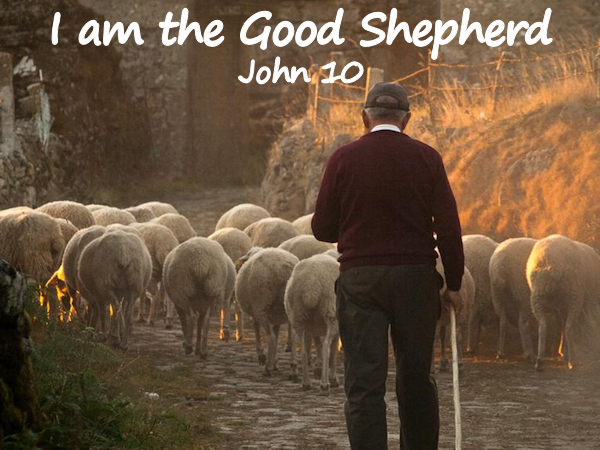
I have been given the subject of Jesus saying, “I am the Good Shepherd,” and it is a glorious theme. In John’s Gospel this is the fourth of the seven great “I am” statements. Each reveals something vital about Jesus: who he is, why he came, what he is like, and what it means to belong to him. These sayings are not passing illustrations but windows into his identity. When Jesus says, “I am,” he reaches back to the burning bush, where God revealed himself to Moses as “I am who I am.” So Jesus is not only describing his work; he is revealing his divine identity. In him, the God who spoke to Moses has come near. That is why these sayings comfort believers and trouble unbelief. They are full of grace, but also full of authority. They call us not merely to admire Jesus, but to know him, trust him, and follow him.
That helps us understand why the reaction to Jesus in John’s Gospel is often so strong. His listeners knew this language carried enormous weight. When Jesus says, “I am the Good Shepherd,” he is not merely claiming to be helpful. He is placing himself at the centre of God’s saving purposes and saying that the life, care, guidance, and safety of God’s people are found in him. In John 10 the claim is especially rich because the image of the shepherd already runs through Scripture. The Lord is the shepherd of his people. Psalm 23 tells of the shepherd who leads, feeds, restores, protects, and stays with his people in the darkest valley. Yet the Old Testament also uses shepherd language for kings and spiritual leaders, and they often failed. They fed themselves instead of the flock and neglected the weak and wandering. So when Jesus says, “I am the Good Shepherd,” he declares that he is the true shepherd God promised, unlike every false shepherd before him.
That contrast is sharpened by Ezekiel 34. There the Lord rebukes the shepherds of Israel because they cared for themselves rather than for the flock. They did not strengthen the weak, heal the sick, bind up the injured, bring back the strays, or seek the lost. The sheep were scattered because the shepherds were selfish. Yet God also promises that he himself will come and seek his sheep and set over them one shepherd, his servant David. Those promises stand behind John 10. Jesus is saying that the promised shepherd has arrived. He is the shepherd sent by God, and more than that, he is the Lord himself caring for his people. He does not exploit the flock; he saves it. This matters especially because John 10 follows the healing of the man born blind in chapter 9. The religious leaders rejected and cast that man out, exposing their cold and blind leadership. False shepherds wound the flock, but the Good Shepherd seeks, receives, and keeps his own.
It is worth noticing that Jesus does not simply say, “I am a shepherd,” but, “I am the Good Shepherd.” The goodness of Christ is moral beauty made visible. He is good in the way he speaks, leads, serves, and gives himself. He does not flatter, but he heals. He does not indulge sin, but rescues sinners. He does not manipulate the sheep by fear, but wins them by truth and love. Christ’s goodness is deeper than mere pleasantness; it is holiness joined to mercy. It makes the weary feel safe without ceasing to be righteous. That is one reason this image has meant so much to Christians through the centuries. It tells us not only that Jesus has power, but that his power is exercised for our good. We are not in the hands of a tyrant, a hireling, or a stranger, but of one who is altogether good.
The first great truth Jesus emphasizes is that the Good Shepherd lays down his life for the sheep. This is not an incidental detail; it is central to his mission. A shepherd protects and guides, but Jesus goes beyond every ordinary expectation. He does not merely risk himself for the sheep. He gives himself for them. His death is not the collapse of his mission but the accomplishment of it. Isaiah says, “All we like sheep have gone astray,” and that describes the human condition. We have wandered morally and spiritually. Yet the wonder of the gospel is that the Shepherd comes after straying sheep and does for them what they cannot do for themselves. He bears their sin, takes their judgment, and gives his life in their place. The cross is not merely an example of love; it is the saving act of the Shepherd for his flock.
Three features of that death deserve attention. First, it is voluntary. Jesus says, “No one takes it from me, but I lay it down of myself.” The cross was not a defeat forced upon him; he chose the path of obedience. Secondly, it is substitutionary. He lays down his life for the sheep. He dies not for his own sin, because he had none, but for ours. The innocent one stands in the place of the guilty. Thirdly, it is victorious. Jesus has authority to lay down his life and authority to take it up again. His death leads to resurrection. The grave does not master him. The Shepherd dies, and the Shepherd rises, and because he lives, his flock lives also. Christian hope is grounded in the living Christ, who has conquered death and now reigns in power.
The second truth in this passage is that the Good Shepherd knows his sheep, and his sheep know him. Here the emphasis shifts from sacrifice to relationship. Jesus does not save an anonymous crowd. He knows his own. He knows our frailty, history, temptations, fears, and wounds, yet he does not turn away. In human experience we often fear that if we were completely known, we would not be loved. But in Christ the opposite is true. He knows us completely and still calls us his own. And the sheep know him. They recognise his voice, trust him, and follow him. In a world full of competing messages, that remains essential. Many voices promise life, security, and peace, but only one voice belongs to the Good Shepherd. The Christian life is a life of learning to hear him and walk after him.
This is where Psalm 23 becomes especially precious. The Lord as shepherd not only leads his people into green pastures; he also walks with them through the valley of the shadow of death. His presence is not limited to bright seasons. He is near in suffering as well as in joy. There are days of ease, but there are also days of grief, confusion, and fear. Yet the sheep of Christ are never abandoned. The Good Shepherd does not disappear when life becomes difficult. He remains present, comforts, corrects, sustains, and leads. Sometimes he changes our circumstances; sometimes he changes us within them. But always he is faithful. To belong to Christ is not to be exempt from trouble; it is to be kept in trouble by the one who has already given himself for us.
The third truth we see in John 10 is the security the Good Shepherd gives to his sheep. Jesus says, “I give them eternal life, and they shall never perish; no one will snatch them out of my hand.” The sheep are not secure because they are strong, but because the Shepherd is. Our ultimate safety rests not in the strength of our grip on Christ, but in the strength of his grip on us. If salvation depended finally on our consistency, who could stand? But Jesus points us away from self-reliance and toward his preserving power. He gives eternal life, keeps his own, and the Father holds them too. This does not encourage carelessness; it encourages confidence in grace. Our hope rests not in our own achievement but in his finished work.
So what should our response be to Jesus the Good Shepherd? It is to trust him, listen to him, follow him, and rest in him. Trust him, because his death for the sheep was willing, substitutionary, and victorious. Listen to him, because his voice is the voice of truth, life, and love. Follow him, because no other leader can guide us as he does. Rest in him, because eternal security belongs to those whom he holds in his hand. The good news of John 10 is that the Shepherd still calls, still seeks, still saves, and still keeps. He is not distant from his sheep or indifferent to their need. He is good, and therefore he can be trusted. Let us draw near to him afresh and say with confidence: the Lord Jesus Christ is my Good Shepherd, and because he is mine, I am safe in his care.