
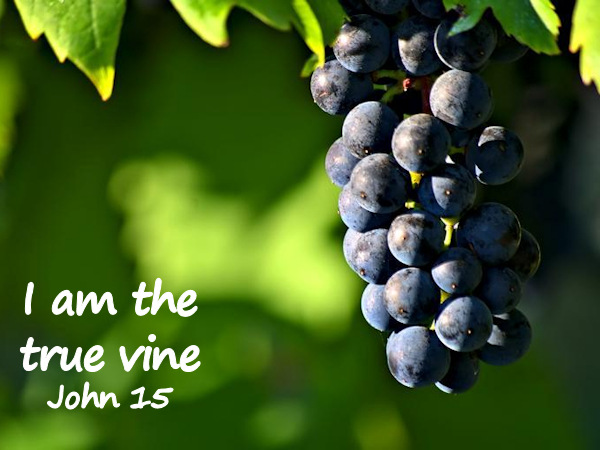
Today we continue our series on the “I am” sayings of Jesus by looking at his words in John 15: “I am the true vine.” Jesus speaks these words on the night before his crucifixion. The cross is near, and he is preparing his disciples for what lies ahead. He knows they will soon face confusion, sorrow, fear, and loss. So he gives them an image that is simple enough to remember, yet deep enough to sustain them. It shows who he is, what it means to belong to him, and how his people are to live.
In these final chapters of John’s Gospel, Jesus is drawing together many of his key themes. He wants his disciples to understand who he is, what their relationship to him must be, and how they are to live once he is gone from their sight. He is equipping them for the life of discipleship that lies ahead. Their strength will not come from self-confidence, ability, or religious effort, but from continuing fellowship with him. The same is true for us. John 15 is for every Christian who wonders how to remain faithful in a difficult and distracting world.
The image of the vine would have been familiar to the disciples. In the Old Testament, Israel is often described as God’s vine or vineyard. God planted his people, cared for them, and looked for fruit from them. Yet those passages often carry a note of disappointment. Instead of justice, there was oppression; instead of faithfulness, there was rebellion; instead of holiness, there was compromise. The vineyard had been lovingly tended, but it did not yield what its owner desired. That background matters because it helps us hear the force of Jesus’ words. He is taking up a long biblical theme and bringing it to its fulfilment in himself.
That is why Jesus says not simply, “I am the vine,” but, “I am the true vine.” Where Israel failed, Jesus succeeds. He is the perfectly faithful one, the true Israelite, the one who fully reveals the Father and perfectly obeys him. Everything that God intended his people to be finds its centre and fulfilment in Christ. He is the one in whom fruitfulness is finally possible. So this passage is not first about our effort; it is first about Jesus himself. The hope of the Christian life begins here: not in the strength of the branch, but in the faithfulness of the vine.
In this picture, Jesus is the vine, the Father is the gardener, and we are the branches. The life of the branch comes only from its connection to the vine, and that reminds us that all true spiritual life comes from Christ through the Holy Spirit. A branch has no independent life in itself. In the same way, Christians do not possess spiritual life as something self-generated or self-sustaining. We receive it from Christ, and we continue in it only by remaining in him. That is both humbling and deeply reassuring: humbling, because it strips away pride; reassuring, because the source of life is not our weakness but his fullness.
Jesus’ words are both comforting and serious. Fruitful branches are pruned so that they may bear more fruit, but fruitless branches are cut off. The warning is clear: a merely nominal connection to Christ is not enough. It is possible to be near the things of Christ and outwardly associated with the people of God, yet still lack spiritual life. What matters is a living, lasting union with him. At the same time, this passage is not meant to drive tender believers into despair. Its purpose is to press us beyond appearances and into the reality of abiding in Christ.
So what is this fruit? It may include the fruit of mission as people come to faith. But the passage points more broadly to a life that reflects the character of Christ. To bear fruit is to become more like Jesus, so that others see something of him in us. Fruit is not mere activity, busyness, or success as the world defines success. The fruit Jesus seeks is the steady, God-given growth of a life shaped by his presence: love, holiness, truthfulness, patience, endurance, and self-giving service.
Jesus reveals the Father perfectly; therefore, the fruit he seeks in us is Christ-likeness. Paul describes that kind of life as the fruit of the Spirit: love, joy, peace, patience, kindness, goodness, faithfulness, gentleness, and self-control. This is the visible evidence of a life rooted in Christ. It is worth noticing that this kind of fruit usually grows quietly rather than dramatically. Often it appears not in spectacular moments, but in ordinary faithfulness: in a patient answer, a forgiven wrong, a prayer offered in weariness, a temptation resisted, a burden quietly carried, a neighbour steadily loved. In such things the life of Christ becomes visible in his people, and the Father is glorified.
How, then, do we bear this fruit? Jesus’ central answer is: remain in me. This repeated command stands at the heart of the Christian life. A branch does not strain to produce life from itself; it simply stays joined to the vine. In the same way, the Christian life begins and continues by abiding in Christ. We never move on from our need of him. To remain in Christ is to live by continual reliance upon him and to find in him the source of everything we need for faithful living.
First, remaining in Christ means obedience. Jesus says, “If you keep my commands, you will remain in my love.” And his command is clear: “Love each other as I have loved you.” Christian obedience is not cold rule-keeping; it is a loving response to the one who first loved us. Nor is it a way of earning his favour. Rather, it is the shape that abiding takes in daily life. If we remain in Christ, we will increasingly want what he wants and seek to walk in his ways. Obedience is not opposed to grace; it is the fruit of grace.
Second, remaining in Christ means letting his word remain in us. His truth cleanses us, shapes us, and directs us. If we want to live fruitful lives, we must be people who listen to Scripture, take it seriously, and allow it to dwell deeply in our hearts. When Christ’s word abides in us, it renews our minds and reorders our desires. We begin to see ourselves, others, and the world in a different light. The word of Christ steadies us when we are confused, corrects us when we wander, and nourishes us when we are weak.
Third, remaining in Christ means dependence. Jesus repeatedly links abiding with prayer: those who remain in him will ask in his name. Fruitfulness is not achieved by self-reliance but by daily dependence on the Lord. Prayer keeps us close to him and guards us from distraction. To pray in Christ’s name is to pray in fellowship with him, shaped by his purposes and trusting in his sufficiency. When we pray, we are confessing our need and turning again to the one in whom all life and fruitfulness are found.
Fourth, remaining in Christ means resting in his love. Jesus does not describe a joyless duty but a life of friendship, joy, and security in him. The more we live in the love of Christ, the more stable and fruitful we become. Many Christians know that they should obey, read Scripture, and pray, yet still live with a sense of distance from God. But Jesus speaks so that his joy may be in his disciples and that their joy may be full. Abiding in Christ means living as those who are deeply loved and gladly welcomed into his fellowship.
That brings us to pruning. Jesus says that every fruitful branch is pruned so that it will become even more fruitful. Pruning is not rejection; it is the careful work of a loving gardener. God removes what hinders growth so that our lives may bear richer fruit for his glory. Sometimes he cuts away obvious sins; at other times he exposes misplaced trusts, ambitions, or comforts that have begun to master our hearts. We may prefer untouched growth, but the gardener seeks fruitful growth. He is committed not merely to our ease, but to our holiness.
That process is often painful. Hebrews reminds us that discipline does not feel pleasant at the time, but it later yields “a harvest of righteousness and peace.” Seasons of hardship may become seasons in which God deepens our trust, loosens our grip on lesser things, and forms Christ more fully in us. Often we only recognise the fruit of such seasons afterwards. We discover that what once seemed only loss has, by God’s grace, become a means of greater humility, tenderness, perseverance, and prayer. The Lord’s pruning is rarely comfortable, but it is never careless. The hand that cuts is the hand of a Father who knows exactly what he is doing.
At the same time, we should speak carefully. Not every sorrow is a direct act of discipline. Some things in life are simply grievous and broken, and we should be slow to explain another person’s suffering with easy formulas. Yet even there, the Lord remains the wise and compassionate gardener, able to bring strength, holiness, and hope out of suffering. The gospel does not teach us to deny pain; it teaches us to trust that pain does not have the final word. Because we belong to Christ, even dark and bewildering seasons are not outside the reach of the Father’s care.
So the message of John 15 is clear and searching. Jesus is the true vine, the Father is the gardener, and we are the branches. Our calling is not to invent life for ourselves but to remain in Christ: obeying his commands, receiving his word, depending on him in prayer, and resting in his love. As we do, he produces in us the fruit of Christ-like character, and even his pruning becomes part of his good purpose. This passage calls us away from superficial religion and back to the centre of discipleship. The question is whether we abide in him. For apart from him we can do nothing; in him, by grace, we are made fruitful.
My prayer is that we would be fruitful branches, closely joined to Jesus, growing in love, obedience, and trust, so that our lives may bring glory to the Father. And where we feel weak, barren, or weary, may this passage draw our eyes back to Christ himself. The hope of fruitfulness is not that we are strong enough, but that he is the true vine, and his life is sufficient for all who remain in him.