
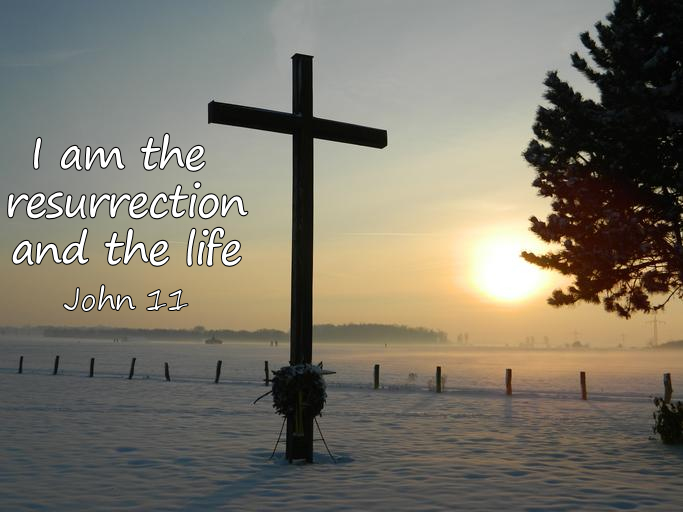
 Jesus has travelled from Jerusalem to Bethany. He has heard that his friend Lazarus has died, and now he stands with Mary and Martha outside the tomb. He enters into a scene of grief, not as a distant observer, but as one who grieves himself. Lazarus was his friend. And yet Jesus comes not only to share sorrow, but to bring comfort, assurance and hope.
The first words Jesus brings to Martha are words of reassurance: Lazarus will rise again. And Martha responds with what she knows. She says, in effect, “Yes, Lord, I know he will rise again on the last day.” She is drawing on the hope deeply rooted in Jewish faith: that there will be a day of judgment, a day of resurrection, a day when God will put things right. Jesus does not correct her. He does not dismiss that hope. In fact, his own teaching speaks of that day too. Think of the parable of the sheep and the goats, where lives are measured by the way people have responded to the hungry, the stranger, the prisoner, the poor and the vulnerable.
So Martha is not wrong. But Jesus wants her to see that there is more. There is a kind of holy “yes, but” in this conversation. Yes, Martha, there is resurrection on the last day. Yes, there is judgment. Yes, God will bring justice. But resurrection is not only an event waiting at the end of history. Resurrection is standing in front of you. “I am the resurrection and the life.”
That phrase matters. Throughout John’s Gospel Jesus keeps saying, “I am.” I am the bread of life. I am the light of the world. I am the gate. I am the good shepherd. I am the resurrection and the life. John wants us to hear that Jesus is not simply a figure from the past, nor merely a promise for the future. He is present reality. He is the one who meets us now, in our grief, our confusion, our questions and our need.
We read this story with the benefit of knowing where it is going. When Jesus speaks to Martha, the cross still lies ahead. The tomb still lies ahead. The stone rolled away, the empty grave, the risen Christ, the ascension, Pentecost—all of that is still to come. But Jesus speaks as the one who already carries resurrection life within himself. He is present to Martha in that moment, and he is present to us in ours.
That means all those images Jesus uses of himself are not just theological ideas to admire from a distance. They are invitations for today. He is bread for our hunger now. He is light for our darkness now. He is shepherd for our wandering now. He is resurrection and life for our deadness now.
Martha says, “I believe that you are the Christ, the Messiah, the Son of God.” Again, she is right. But again, Jesus expands her understanding. Messiahship stretches all the way back through the story of Scripture: the promise that one would come to deal with the evil, chaos and separation that entered the world; the hope of a king from David’s line; the longing for one who would overthrow the oppressor and crush evil. Jesus is that Messiah, but he does it in a way many did not expect. He goes to the cross. He is pierced for our transgressions and bruised for our iniquities. He takes upon himself the sin, darkness and disorder of the world.
And before Jesus goes to his own tomb, he gives Martha tangible evidence. He calls Lazarus out. A man four days dead is lifted from death into life. Lazarus becomes a signpost, a foretaste, a living demonstration of what Jesus means when he says, “I am the resurrection and the life.” Jesus has authority to lift people out of deadness.
And that brings us to Paul’s words in Ephesians. Paul writes to a community of churches around Ephesus, in what we now know as modern-day Turkey. He is desperate for them to grasp what it means to belong to Christ. He says that Jews and Gentiles—really, the whole of humanity—were dead in transgressions and sins. It is a strange phrase, because he is writing to people who are physically alive. But Paul is describing a deeper condition: life cut off from the fullness God intends; existence trapped under the weight of sin, chaos and darkness.
Then Paul gives the God solution: “It is by grace you have been saved.” Grace is gift. Not a reward. Not wages. Not something earned by effort, goodness or religious achievement. We have all sinned and fallen short of the glory of God. We cannot reach the mark by ourselves. And yet God, in mercy, gives what we could never buy and could never repay. It is like a benefactor lavishing unimaginable wealth on a merchant who has no ability to settle the debt. The only fitting response is faith: committed, trusting, ongoing allegiance.
So when we see Jesus taking our sins and transgressions upon himself, when we see him carrying judgment so that we need not bear it, the only true response is love, trust and surrender. And what do we receive? We are lifted out of deadness. The same power that raised Jesus from the grave raises us into new life. We are not simply forgiven and left where we were. We are made alive with Christ.
Paul goes even further. He says God has raised us up with Christ and seated us with him in the heavenly realms. That is extraordinary. Our present position, in Christ, is closeness to God. N. T. Wright captures something of this when he says that those in whom the Spirit dwells are people who live at the intersection of heaven and earth. That is where the church lives. That is where we live: here, in our ordinary community, yet carrying something of heaven because the Spirit of God lives in us.
What does that mean in practice? It means we are close to God. I do not know how close you feel to God today. We look at the world and see war, injustice, political confusion, young people struggling, health and social care under pressure, families carrying burdens, communities feeling stretched. God is not indifferent to that. His heart is moved by the chaos and darkness that break our hearts too. But because we have been raised with Christ, we can look at that chaos from a new perspective.
It does not mean we stop feeling pain. It does not mean we switch off our minds or pretend everything is fine. Living at the intersection of heaven and earth means we see the earth honestly and bring heaven faithfully. We can ask God, “How do you see this? What is your heart here? How do you want me to respond?” We are lifted above hopelessness, above despair, above the things that would rob us of dignity, peace and purpose—not so we can escape the world, but so we can serve it.
This resurrected life is for now. Of course there is future hope. Of course one day God will put all things right. But we do not have to wait until then to live with hope, confidence and peace. There is an empty tomb, and because there is an empty tomb, chaos does not get the final word. Death does not get the final word. Sin does not get the final word. Jesus does.
And that gives us purpose. We are part of God’s solution. In our relationships, conversations, workplaces, friendships, coffee mornings, pastoral visits, bowls clubs, homes and streets, we can bring something of heaven to earth. We can bring hope where there is despair, reassurance where there is fear, perspective where there is confusion, and love where there is isolation. We do not do this in our own strength. We do it by the Holy Spirit—the same Spirit who raised Jesus from the dead.
So I do not know how you are doing this morning. I do not know whether you feel hopeful or hopeless, peaceful or anxious, full of faith or running on empty. I do not know what worries you, what troubles you, what lens you are looking through, or where you feel tired and worn down by life. But I do want to say this: in Christ, you can be lifted out. You can be raised from deadness into life. You can know the resurrection and the life not only as a doctrine, but as a present reality.
Resurrection needs a death. So what in your life needs to be surrendered? What needs to be put to death so that Christ can bring new life? What do you need to be lifted out of today? Let us take a moment of quiet and come before the God who raised Jesus from the tomb, the God who meets us in our present, and simply say: Lord, I need some resurrection here.