
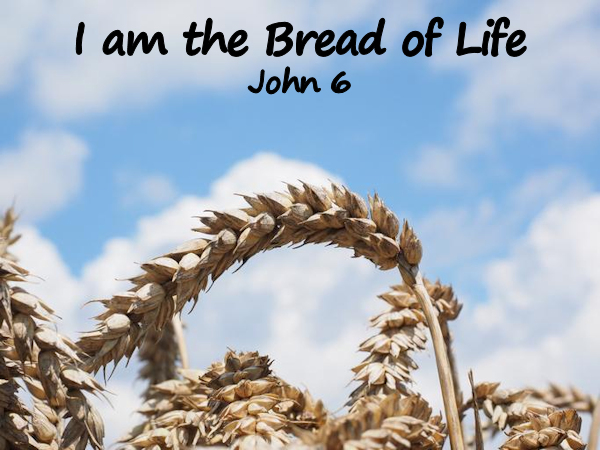
We’re continuing our series on Jesus’ “I AM” statements. In a few weeks we’ll return to consider “I am the vine,” but today we’re reflecting on Jesus’ words in John 6: “I am the bread of life.”
To get there, let me begin with a brief digression about staple foods—the everyday foods that quietly make up the dominant share of a normal diet. In the UK it can feel as though we don’t have one true staple. Our supermarkets offer huge variety, and many of us rotate through favourite meals rather than relying heavily on a single basic ingredient.
But in many parts of the world—and certainly in the ancient world—diet looked very different. A small number of crops provide most of the calories people consume. Grains such as rice, maize, and wheat account for a remarkable share of global calorie intake; and, taken together, a relatively small group of plants supplies the vast majority of what humanity eats.
Even within our own country, a significant portion of our diet comes from cereals, alongside meat, dairy, fish, fats, oils, and sugars. But if you imagine first-century Palestine, the balance would likely have been more heavily weighted toward basic grains—less meat, less fish, and more dependence on bread.
That matters, because when the crowd heard Jesus speak about bread, they weren’t thinking of a special treat. Bread was the staple—the ordinary, dependable food that carried people through the week. So when Jesus says, “I am the bread of life,” he isn’t primarily saying, “I am a luxury.” He is saying, “I am essential. I am what you must have to truly live.”
Of course, we can still picture the best bread imaginable—warm, fresh, and satisfying. But the emphasis in John 6 is less about “deliciousness” and more about “completeness”: bread as the regular portion of the diet, the food that sustains, the thing you rely on. Jesus is presenting himself as the one who sustains life at its deepest level.
The background is important. The day before, the crowd had experienced the feeding of the five thousand: Jesus took five loaves and two fish and fed a vast number of people. Later he walked on the water—an event not everyone witnessed, but the story certainly spread. And now the crowd is eager to find him again.
We can understand some of their motivation. Hunger was a regular feature of ordinary life. They had eaten well the previous day, and it’s easy to imagine the thought: “Let’s go and see if we can get another meal.” Alongside that practical desire was a spiritual expectation many people carried—that when the Messiah came, the provision of manna in the wilderness would somehow be renewed, as though God would once again supply bread from heaven to meet the nation’s needs.
So they press Jesus: “What sign then will you give that we may see it and believe you? … Our ancestors ate the manna in the wilderness.” In other words, “Feed us again. Prove yourself again.” They’re evaluating Jesus mainly by what he can do for them, rather than receiving him for who he is: the Son of the living God.
Throughout Scripture, God often uses something practical and physical in the Old Testament to point toward something deeper and spiritual in the New Testament. A sign in history becomes a window into the gospel. So here, the manna in the wilderness becomes a way of understanding Jesus’ claim to be the bread of life. We can reason from the lesser gift to the greater: from manna to Christ.
As we do that, I want to highlight three aspects of God’s character and God’s provision that come into focus through this “bread” imagery: Jesus satisfies universally, completely, and permanently.
Manna was bread from heaven that sustained Israel during their journey through the wilderness. Exodus describes it in homely detail—white, small, gathered day by day, and given in just the right measure. It was a real provision for a real people in a real desert. But it was, in a sense, limited: it fed a particular nation for a particular season.
Jesus takes that familiar story and expands it beyond all borders. “I am the living bread that came down from heaven… This bread is my flesh, which I will give for the life of the world” (John 6:51). The scope is breathtaking. The bread of life is not restricted by geography, ethnicity, language, or background. Whoever comes may eat; whoever believes may live.
One of the ways the church lives out that truth is through communion. Across time zones and cultures, Christians take bread and wine as a shared act of remembrance and trust. The outward action is simple; the inward reality is profound: union with Christ, trust in his sacrifice, and dependence on grace we cannot earn.
Manna met physical hunger. It was daily calories for weary travellers. But Jesus speaks of a deeper hunger and a deeper life. In John’s Gospel, miracles are never mere spectacle; they are signs pointing to Jesus’ identity. The crowd, however, makes a common mistake: they confuse the sign for the substance. They want bread for their stomachs, while Jesus offers life for their souls.
When Jesus says that the bread of God “comes down from heaven and gives life to the world,” they reply, “Sir… always give us this bread.” They still imagine something tangible that will keep them from hunger. But Jesus is speaking metaphorically: he is inviting them to come to him, to trust him, to “feed” on him by faith.
That is why some grumble: “Is this not Jesus, the son of Joseph…? How can he now say, ‘I came down from heaven’?” And later, many say, “This is a hard teaching. Who can accept it?” The difficulty is not that the imagery is complicated; it’s that the claim is enormous. Jesus is not merely offering help. He is claiming to be heaven’s provision—God’s answer to humanity’s deepest need.
And this is still a live issue today. Many people instinctively chase the material and sideline the spiritual—achievement, experience, reputation, comfort. Yet even those who accomplish much can find themselves strangely unsatisfied, describing a restless weariness that success cannot cure. Jesus’ promise is different: “Whoever comes to me will never go hungry, and whoever believes in me will never be thirsty.”
So what does it mean when Jesus speaks of eating his flesh and drinking his blood? At the very least, John 6 itself interprets the metaphor for us: “My Father’s will is that everyone who looks to the Son and believes in him shall have eternal life, and I will raise them up at the last day” (see John 6:40). To “eat” is to believe—to receive Jesus personally, to trust him, to make him your life. Augustine put it memorably: Believe, and you have eaten.
And yes, the language also points us toward communion, where Jesus gives bread and wine as signs of his body and blood, and tells his disciples to remember him. But the core invitation is larger than a single rite: to live in ongoing dependence on Christ—strength for the inner life, and fuel for our calling to love God and love our neighbour.
Manna had a strict “use-by date.” Gather too much and the excess went bad. Keep it overnight and it spoiled. God designed it that way to teach Israel daily trust: each morning brought fresh provision, and yesterday’s bread could not be hoarded as a substitute for today’s dependence.
But Jesus’ promise is not time-bound. “I am the bread of life… whoever comes to me will never go hungry” (John 6:35). “Whoever eats this bread will live forever” (John 6:51). And again: “Your ancestors ate manna and died, but whoever feeds on this bread will live forever” (John 6:58). The life Jesus gives is lasting—communion with God that death itself cannot undo.
That gift comes to us by grace—freely given, not earned—and it comes at great cost to Jesus. Philip Yancey famously wrote that grace is “unfair”: we deserve judgement and receive mercy; we deserve punishment and receive forgiveness. The “wages” of sin is death, but the “gift” of God is eternal life. The permanence of this bread is secured by Christ’s sacrifice.
So we see the shape of Jesus’ claim: the bread of life satisfies universally (for the world), completely (body, mind, and soul), and permanently (forever).
As we bring this home, here are three simple questions to carry with you—perhaps even as you think about what you’ll eat for lunch today.
First: What “bread” am I working for? Jesus says, “Do not work for food that spoils, but for food that endures to eternal life” (John 6:27). Many good things motivate us—work, money, friendships, family, comfort, recognition. But none of them can carry the weight of being our ultimate source of life. Are we seeking Christ as essential, or treating him as optional?
Second: Am I actually receiving grace, or merely agreeing with it in theory? Jesus says, “The work of God is this: to believe in the one he has sent” (John 6:29). Some of us stumble here, not because we deny forgiveness for others, but because we quietly exclude ourselves: “Yes, grace is real… but not for me.” Yet the bread of life is given, not achieved. Nothing can separate those who come to Christ from the love of God in him.
Third: What is my regular “soul diet”? Bread is a staple—routinely eaten, shaping strength over time. In a culture that constantly offers leisure, pleasure, and treasure as ultimate goods, what is actually feeding our hearts day by day? The question isn’t whether we enjoy good gifts—many are genuinely good—but whether we keep a wise balance, and whether Christ is the dominant portion of our inner life through prayer, Scripture, worship, and obedience.
Jesus, the bread of life, is available to all. He is enough—nothing else is needed to complete what he gives. And he is forever—offering eternal life to all who look to him and believe. May we come to him, feed on him by faith, and find the deep satisfaction he promises.