
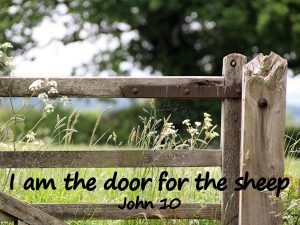
There is something both humbling and comforting about the Bible’s repeated picture of God’s people as sheep. Humbling, because sheep are not known for their brilliance or independence; comforting, because the image assumes a shepherd who stays close, who provides, who protects, and who leads. When Jesus speaks about sheep and shepherds, he is not trying to insult us; he is telling the truth about our need, and then offering himself as the answer.
In John 10:1–10 Jesus uses everyday scenes from village life to reveal something eternal. He describes a sheepfold, a gate, a gatekeeper, and voices in the night. He warns about thieves and robbers. And then he makes a claim that is as simple as it is astonishing: he is the gate. Not merely a guide who points at the entrance, and not one option among many doors, but the one through whom life with God is opened.
For Jesus’ first hearers, the imagery landed immediately. Sheep were woven into their economy and their imagination. Shepherds were familiar figures on the hillsides, and sheep were familiar sacrifices at the altar. The Lord is my shepherd, Psalm 23 sings, and weary hearts have clung to that line for centuries. Isaiah pictures the suffering servant led like a lamb to the slaughter, a prophecy fulfilled when Jesus lays down his life. Again and again Scripture returns to the same truth: God does not merely tolerate his people; he shepherds them.
If we are honest, we sometimes resist being compared to sheep. We would prefer images that feel stronger: builders, warriors, athletes, leaders. Sheep sounds passive, unimpressive, even foolish. Yet the longer we live, the more we recognise ourselves in the metaphor. We do wander. We do get distracted. We do lose direction when fear rises, when pain hits, when decisions pile up, when sorrow drains our strength, or when success makes us careless. And if we are sheep, then we need a shepherd.
Jesus says the sheep know his voice. That is not mystical language meant only for spiritual elites; it is the steady result of closeness. A sheep learns the sound of its shepherd because the shepherd is present day after day. In the same way, we learn to recognise Jesus’ leading as we stay near him—through prayer that is honest, not performative; through Scripture that is opened, not merely admired from a distance; through obedience that is chosen in small moments; and through fellowship where we are encouraged, corrected, and strengthened.
One of the quiet tragedies of modern life is that we can be surrounded by noise and still starve for the voice of God. Work expands to fill every corner. Messages arrive at all hours. Responsibilities are real and often unavoidable, and caring for family is a holy calling. Yet it is possible to be constantly active and gradually become spiritually anaemic. If we do not make room for God, we will not drift into intimacy with him by accident. The voice of Jesus is heard most clearly by those who have learned to pause and listen.
This pressure is felt especially by younger generations. Many face unstable work, expensive housing, anxious relationships, and a culture that promises freedom yet often delivers exhaustion. Some carry despair quietly. In a world like this, the shepherd image is not sentimental; it is necessary. Pray for young people you know—children, grandchildren, neighbours, friends at church. Pray that they will not be swallowed by cynicism, and that they will encounter Jesus not as a distant idea but as the living shepherd who calls them by name and leads them into life.
Jesus does not only speak about sheep and shepherds; he also speaks about thieves and robbers. Not every voice that calls to us is safe. Not every path that looks open leads to peace. Some influences promise life while quietly stealing it—stealing attention, stealing joy, stealing purpose, stealing purity, stealing hope. Jesus warns that there are those who do not enter by the gate. They climb in another way. They are not interested in the sheep’s good; they are interested in using the sheep.
Sometimes the thieves are obvious: temptations we already know will harm us. Sometimes they are respectable: ambitions that look sensible, desires that society applauds. Jesus cautions us to look for fruit. Matthew 7 reminds us that not everyone who speaks confidently is genuine. A promise of fame, wealth, or comfort can sound persuasive, especially when life feels hard. Yet Jesus tells us to store treasure in heaven, because earthly treasure is fragile. Rust corrodes it, moths eat it, markets shift, health changes, and time runs out. If our security rests on what can be taken, we will live anxious lives.
Think of the rich fool in Luke 12. He had a bumper harvest and planned bigger barns, convinced he had secured his future. His dream was simple: relax, eat, drink, and be merry. But God calls him a fool because his soul would be demanded that very night. The story is not an attack on planning or provision; it is a warning about trusting in the wrong saviour. None of us is guaranteed tomorrow. That truth can feel frightening, but it can also be clarifying. It pushes us to ask what really matters, and whether we are living in a way that makes sense in the light of eternity.
Or remember the rich young ruler in Matthew 19. He wanted eternal life, and he had a respectable record. Yet when Jesus exposed the thing he clung to most tightly, he went away sorrowful. Wealth was not his only problem; divided allegiance was. Jesus’ point is searching: we cannot follow him while insisting on carrying every treasure and every title that competes with him. At some point, we must choose what we will release so that we can enter.
So it is worth asking, without defensiveness: what is distracting me? What regularly pulls my heart away from Jesus? It may be money, but it could also be approval, control, comfort, a private habit, a consuming schedule, a long-held resentment, or even a good desire that has become an ultimate demand. Thieves and robbers do not always break in with violence; sometimes they enter quietly through neglect. They coax us into living as if God were optional.
John Bunyan’s Pilgrim’s Progress captures this struggle vividly. Christian begins with a burden he cannot shake and a dissatisfaction he cannot ignore. He hears there is a gate to life and sets out to find it. Almost immediately voices rise to stop him: one mocks him as foolish, another walks with him briefly but quits when the journey becomes hard, and still others offer easier routes that promise relief without repentance. Yet Christian is helped back onto the path again and again until, at last, he reaches the gate and then the cross, where his burden falls away. The story resonates because it mirrors real discipleship: we are often tempted to turn aside, but grace keeps calling us forward.
Here is the heart of Jesus’ words in John 10: he is the gate. A gate is wonderfully ordinary. It is not flashy; it is simply the place you must pass through to be safe, to belong, and to come home. When Jesus says he is the gate, he is saying there is real security and real salvation, but it is not achieved by our effort or earned by our moral record. It is received by coming to him. The claim is exclusive—there is one gate—but it is also deeply generous, because the gate is open to anyone who will enter.
Jesus also speaks of a narrow gate in Matthew 7. The wide road, he says, is easy and crowded; the narrow way is harder to find. “Narrow” does not mean mean-spirited. It means specific. You cannot wander into it while drifting with the crowd. You do not carry every attachment through it. You come honestly, acknowledging your need. You come repentantly, turning from sin. You come trustingly, resting the weight of your life on Jesus. In that sense the gate is narrow, because pride does not fit through it.
This is where many people struggle, including people of sincere faith in other religions and many who consider themselves spiritual but not Christian. We often assume that salvation—acceptance by God, peace in the life to come—must be earned by enough good deeds or achieved by perfect rule-keeping. I once spoke with a taxi driver who described salvation as the outcome of strict obedience, weighed at the end of life. It was a respectful conversation, and it highlighted a crucial difference: the gospel is not “try harder and maybe you will be accepted.” The gospel is that no one is perfect, and therefore no one can save themselves. Jesus saves sinners who come to him.
We do not earn salvation; we receive it. Jesus died and rose again to deal with the barrier between us and God—our sin, our self-rule, our refusal to trust him. When we repent and surrender, we are not paying God back; we are coming home. And the obedience that follows is not a grim attempt to impress God; it is the fruit of a new heart, empowered by the Holy Spirit who comes to dwell within believers. The gate leads not merely to forgiveness but to a transformed life.
Jesus’ picture becomes even more tender when we remember how shepherds protected their sheep at night. In many places the sheepfold had a single opening. When the sheep were inside, the shepherd would lie down across that entrance. He became, quite literally, the door. Any predator would have to go through him to reach the flock. When Jesus says he is the gate, he is not describing a cold checkpoint; he is describing personal protection purchased at personal cost. He stands between his people and the threats that would destroy them.
That protection includes the quiet assurance of God’s presence. Psalm 139 reminds us that there is no moment when God is absent: he knows when we sit and when we rise; he perceives our thoughts from afar; even the darkness is not dark to him. This does not mean we will avoid hardship. Jesus never promises a trouble-free life. But it does mean we are never abandoned in hardship. The gate is not only the way into the fold; it is the assurance that the shepherd stays awake through the night.
Jesus ends this section with a promise that reaches beyond mere survival: “I have come that they may have life, and have it to the full.” The thief steals and kills and destroys; Jesus gives life. Full life is not the same as easy life. It is life rooted in forgiveness, steadied by truth, strengthened by hope, and guided by a shepherd who knows the way. It is life that can face loss without despair, success without pride, temptation without surrender, and uncertainty without panic—because it is held by Christ.
Today, then, the question is not whether you are the sort of person who needs a shepherd; the question is whether you will listen when the shepherd calls. Are there voices you have trusted more than Jesus? Are there loads you are clinging to that keep you from entering freely? Bring them to him. Step again through the gate—through repentance, through trust, through surrender. And as you do, ask for the quiet grace to recognise his voice in the ordinary rhythms of your day. Lord Jesus, keep me near you. Protect me from what would steal my life. Lead me in the way that is truly life, until I am safely home.